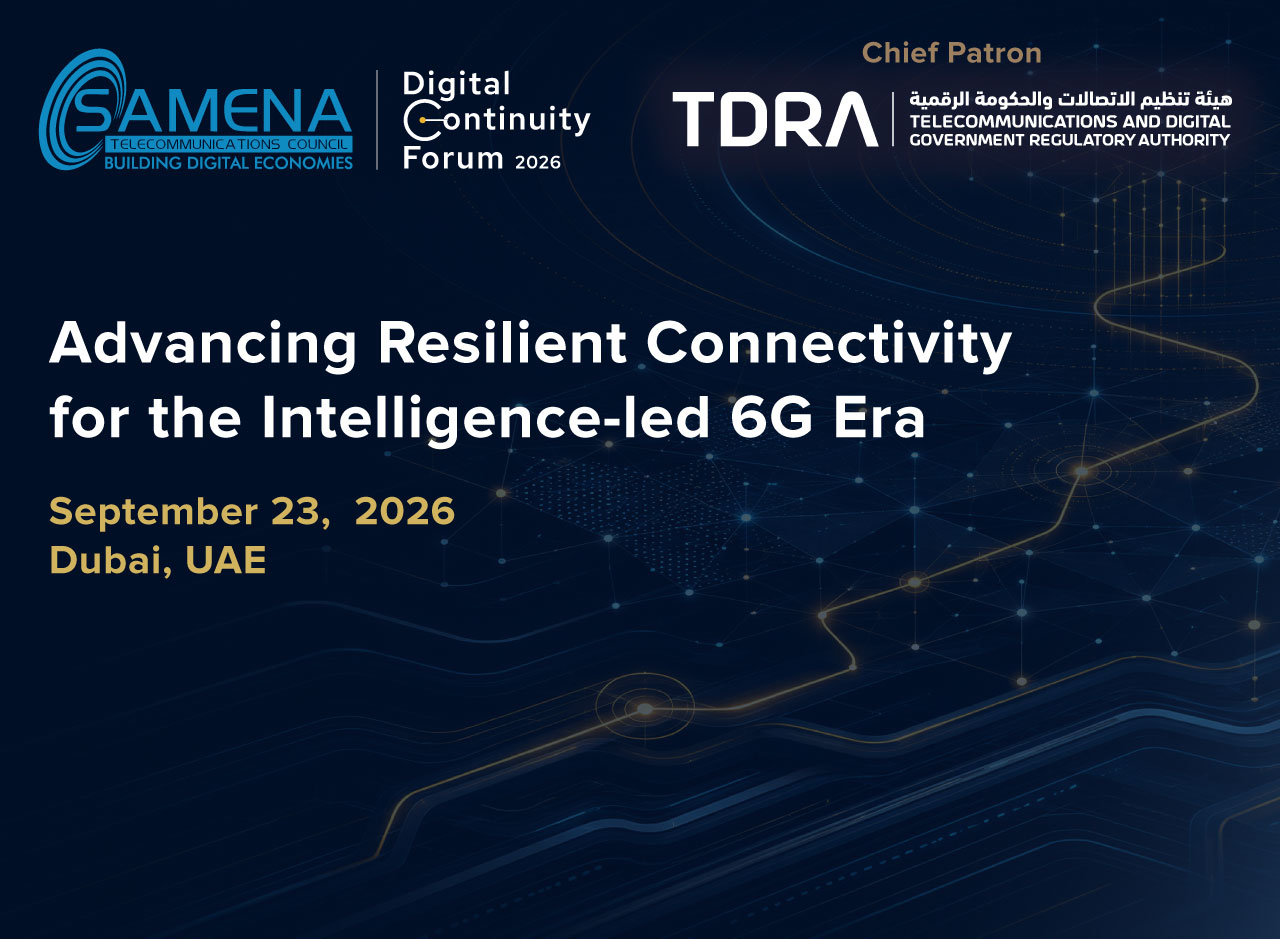
Advancing Resilient Connectivity for the Intelligence-led 6G Era

The Digital Continuity Forum (DCF) brings industry leaders together to shape trusted digital development through resilient ICT infrastructure, future wireless networks, innovation, standardization, and local ecosystem development.

00

Days

00

Hours

00

Minutes

00

Seconds

Digital Continuity Forum 2026

Bringing the region together to shape the future of trusted digital connectivity.

SAMENA Council Digital Continuity Forum 2026

Regional Platform for Network Resilience and Digital Continuity

The SAMENA Council DCF serves as a platform for regulators, telecom executives, standards organizations, technical experts, and technology providers together to examine regulatory expectations, resilience architectures, operational requirements, and the progression from carrier-grade to mission-critical and sovereign-grade networks.

DCF addresses how networks remain continuous, resilient, sovereign and increasingly autonomous as the industry moves into more intelligent and advanced network environments. .

Before the region discusses 6G deployment, it must first define the continuity and resilience foundations on which 6G-era infrastructure will depend


The region is entering a more demanding phase of digital development. Broadband expansion, mobile leadership, cloud adoption, AI, private networks, future wireless systems, and 6G will increasingly depend on ICT foundations that are protected, dependable, standards-based, and resilient.

Its timing ahead of PP-26 provides industry stakeholders a timely platform to advance relevant regional positions and build technical authority in building region-wide momentum on Network Resilience


Agenda

09:00 AM - 10:00 AM

10:00 AM - 10:10 AM

Opening Remarks

TDRA-UAE | SAMENA Council

DCF 2026 opens from a practical premise: the next stage of network evolution will only be as dependable as the infrastructure, operational disciplines and cross-sector dependencies supporting it today. As communications networks become more software-driven, automated and embedded in essential economic and public services, continuity must be considered alongside capacity, speed and innovation. The opening will frame resilience, recoverability and preparedness as immediate priorities, and as part of the groundwork for future-network development.

  • Digital continuity as an immediate industry and national infrastructure priority.
  • Network resilience as a prerequisite for increasingly intelligent and autonomous networks.
  • The need to address dependencies across networks, cloud, computing, power and security.
  • Future-network readiness as a matter of capability and preparedness, not technology timing alone.

10:10 AM - 10:25 AM

Huawei Executive Keynote

Network Resilience for the Intelligent and Sovereign Digital Era

As networks evolve toward full automation and software-driven operation, the autonomous architecture must fundamentally embed carrier-grade resilience, reliability, and operational control. This keynote highlights how Autonomous Networks, powered by Agentic AI are redefining resilience from reactive recovery to predictive avoidance. We examine three enabling pillars—Connection Quality, Network Resilience, and Network Security. Ultimately, Autonomous Networks fortified by AI-driven resilience not only slash operational complexity but also ensure that carrier infrastructures remain trustworthy, adaptive, and continuously available—making resilience the very bedrock of intelligent, future-proof network operations.

  • The evolution of Autonomous Networks empowered by Agentic AI
  • Autonomous network architecture designed around resilience and continuity.
  • Connection Quality, Network Resilience, and Network Security
  • Technology evolution toward intelligent and AI-native networks.

10:25 AM - 10:35 AM

CMI Executive Keynote

Autonomous Networks as an Enabler of Digital Continuity

As networks grow in scale and complexity, maintaining continuity will increasingly depend on the ability to detect changing conditions, make decisions and restore service faster than manual operations alone can allow. This keynote may explore where autonomous network capabilities can strengthen that operational response, including fault detection, traffic management and recovery. It may also consider the corresponding requirement that automation, orchestration and control systems remain dependable when the network itself is under stress.

  • Autonomous operations as a means to improve continuity and recovery.
  • Faster fault detection, response and service restoration.
  • The resilience of the automation and control systems themselves.
  • Operational lessons that can prepare networks for greater future autonomy.

10:35 AM - 10:45 AM

Huawei Executive Keynote

Autonomous Networks for Carrier-Grade Resilience and Intelligent Operations

As networks evolve toward full automation and software-driven operation, the autonomous architecture must fundamentally embed carrier-grade resilience, reliability, and operational control. This keynote highlights how Autonomous Networks, powered by Agentic AI are redefining resilience from reactive recovery to predictive avoidance. We examine three enabling pillars—Connection Quality, Network Resilience, and Network Security. Ultimately, Autonomous Networks fortified by AI-driven resilience not only slash operational complexity but also ensure that carrier infrastructures remain trustworthy, adaptive, and continuously available—making resilience the very bedrock of intelligent, future-proof network operations.

  • The evolution of Autonomous Networks empowered by Agentic AI
  • Autonomous network architecture designed around resilience and continuity.
  • Connection Quality, Network Resilience, and Network Security
  • Technology evolution toward intelligent and AI-native networks.

10:45 AM - 11:15 AM

Foundational Panel

Digital Continuity as the Foundation for Future Networks

Digital continuity concerns the ability of essential digital services to remain available, or to recover within an acceptable period, when one or more underlying systems are disrupted. That challenge now extends across telecom networks, cloud and computing infrastructure, power, software platforms and other dependencies that no single stakeholder controls end to end. The session places this broader continuity requirement at the foundation of future-network planning, asking what service expectations, responsibilities and resilience capabilities need to be defined now as networks become more autonomous and interconnected.

Baseline Discussion Questions

  • What should digital continuity mean from a telecom-sector perspective, and how is it distinct from conventional network resilience or business continuity?
  • Which dependencies now have the greatest effect on service continuity across the digital infrastructure chain?
  • Where are the most important continuity gaps when responsibility is divided among operators, cloud providers, infrastructure providers, technology vendors and public institutions?
  • What minimum levels of service should critical digital infrastructure be expected to maintain during disruption?
  • How should continuity be assessed across an end-to-end service rather than through the availability of individual components?
  • Which capabilities should be strengthened during the 5G and 5G-Advanced period so they do not become weaknesses in future networks?
  • Where could regional cooperation materially improve digital continuity and recovery?

11:15 AM - 12:15 PM

Resilience Panel

Network Resilience, Sovereign Infrastructure, and Future-Network Readiness

Future networks will depend on a wider set of distributed assets, software platforms, computing resources, data environments and external infrastructure than earlier network generations. Resilience therefore depends not only on redundancy, but on knowing which functions are critical, where dependencies sit, what can be restored locally and how much operational control can be retained during disruption. This session, with participation from leading technology providers, connects these questions with sovereign infrastructure requirements, examining the capabilities that operators and national systems may need in place before future networks become more deeply integrated into critical economic and public functions.

Baseline Discussion Questions

  • Which network functions and infrastructure capabilities require the greatest operational control, visibility or recovery capability?
  • How should sovereignty be understood in networks that depend on cross-border infrastructure, software, cloud services, standards and supply chains?
  • Which dependencies currently create the greatest resilience exposure for telecom networks?
  • Where is additional redundancy justified, and where should resilience investment be concentrated because the consequences of failure are highest?
  • What should operators be able to restore locally if external systems, international links, cloud platforms or vendor support become unavailable?
  • How can resilience requirements be built into procurement, architecture, operations and regulation rather than addressed after deployment?
  • Which resilience and sovereign capabilities developed now will become prerequisites for future networks?

12:15 PM - 12:30 PM

Launch Ceremony

GCC Network Resilience Joint Initiative

The GCC Network Resilience Joint Initiative is intended to turn a shared regional concern into a continuing area of practical industry engagement. GCC networks operate within an interconnected environment shaped by common technology platforms, international connectivity, supply chains and critical digital-service dependencies.
The initiative launch sets an imperative for identifying issues that benefit from regional attention, comparing operational experience and developing areas of cooperation that can strengthen continuity without displacing national responsibilities.

Launch Focus

  • A continuing regional mechanism focused on network resilience and digital continuity.
  • Identification of common dependencies and resilience priorities across GCC markets.
  • Exchange of relevant operational experience and possible areas for practical cooperation.
  • Follow-up work that can inform future DCF discussions and regional engagement.

12:30 PM - 01:20 PM

Critical Protection Panel

Critical Infrastructure Security and Digital Continuity: Keeping Networks Operational Under Stress

Critical infrastructure security is ultimately tested by whether essential services can continue when prevention fails or disruption cannot be avoided. Cyber incidents may coincide with software faults, physical damage, such as through regional conflicts, power loss, cloud outages or failures elsewhere in the infrastructure chain, creating conditions in which normal operating assumptions no longer hold. This session aims to focus on continuity under those conditions: protecting essential functions, containing the spread of failure, operating in degraded states where necessary, and restoring service through coordinated technical and institutional response.

Baseline Discussion Questions

  • How should security planning change when maintaining essential service during an incident is treated as a core objective?
  • Which forms of disruption create the greatest continuity risk for modern telecom infrastructure?
  • Which network functions should remain available when parts of the infrastructure must operate in a degraded or isolated state?
  • How should operators establish service priorities when full capability cannot be restored immediately?
  • Which technical and organizational capabilities have the greatest effect on recovery time?
  • How should telecom operators coordinate with government and other critical infrastructure providers during major disruption?
  • What new continuity risks arise as increasingly important network operations depend on automation and AI-assisted systems?

Parallel Roundtable

WAA & SAMENA Council – WLAN Ecosystem Development & Stakeholder Introductions

Wi-Fi and WLAN are part of the everyday access fabric through which users, enterprises and institutions reach digital services, particularly indoors and in high-density environments. Their role is expanding alongside mobile networks as traffic patterns, enterprise requirements and new device environments evolve. The roundtable will consider what is required for a stronger regional WLAN ecosystem, including spectrum conditions, operator participation, integration with wider connectivity strategies and engagement between industry, regulators and users. Within DCF, through the collaboration of two industry bodies, it also provides a practical access-layer perspective on service availability and complementary connectivity.

Baseline Discussion Questions

  • Where does WLAN provide the greatest strategic and commercial value within the region's wider connectivity environment?
  • How should operators approach the relationship between licensed mobile networks and Wi-Fi as indoor and enterprise connectivity requirements increase?
  • Which spectrum conditions are most important for the development of next-generation WLAN services?
  • What currently limits stronger operator participation in the WLAN ecosystem?
  • Which enterprise, industrial, public-sector or residential use cases could justify greater regional WLAN investment?
  • Where can WLAN contribute meaningfully to service continuity or complementary access?
  • What concrete stakeholder engagements should follow the roundtable?

01:30 PM - 02:15 PM

02:15 PM - 02:55 PM

Future Readiness Panel

Future Network Readiness: 6G, AI-Native Networks, Standards, Spectrum, Security and Regional Participation

Meaningful preparation for 6G begins well before a commercial deployment decision. Choices being made now around 5G-Advanced evolution, network architecture, automation, computing, security, spectrum and standards will determine how readily future capabilities can be introduced and how resilient they will be once deployed. The session treats 6G as a preparedness question rather than a forecast: what foundations need to be strengthened, which requirements should the region help shape internationally, and how can regional participation move beyond technology adoption toward influence over standards, spectrum priorities and future network requirements.

Baseline Discussion Questions

  • Which decisions taken during the 5G and 5G-Advanced period will have the greatest effect on future 6G readiness?
  • What should governments and operators prioritize now before focusing on eventual 6G deployment timelines?
  • What does an AI-native network imply operationally, and which dependencies must be made sufficiently resilient first?
  • How should spectrum planning begin for future networks while protecting existing investment and services?
  • Which security issues need to be addressed at the architecture and standards stage rather than after deployment?
  • How can regional operators, regulators, research institutions and technology companies participate more directly in international standards and requirements development?
  • What would constitute meaningful regional 6G readiness beyond trials, announcements and technology demonstrations?

02:55 PM - 03:00 PM

Closing Session

DCF Key Messages and SAMENA Council Announcements

DCF 2026 is intended to leave behind more than a record of individual sessions. The closing will draw together the principal areas of convergence, unresolved questions and priorities that merit continued attention across industry and institutions. It will also connect the day's discussion with SAMENA Council follow-up, including the DCF Outcome Note and future stakeholder engagement, so that digital continuity and network resilience remain part of an ongoing regional work program rather than a one-day event theme.

  • Resilience and continuity messages emerging from the Forum.
  • Areas requiring continued industry and institutional engagement.
  • Relevant SAMENA Council follow-up and announcements, e.g., future stakeholder meetings.
  • Continuation of the discussion through the DCF Outcome Note and related engagement.

Digital Continuity Forum 2026

SPONSORS & PARTNERS

SAMENA Council Digital Continuity Forum 2026

News & Updates

Call Now!

+971.4.3642700

E-mail Us!

[email protected]

Contact Us

For inquiries, get in touch!